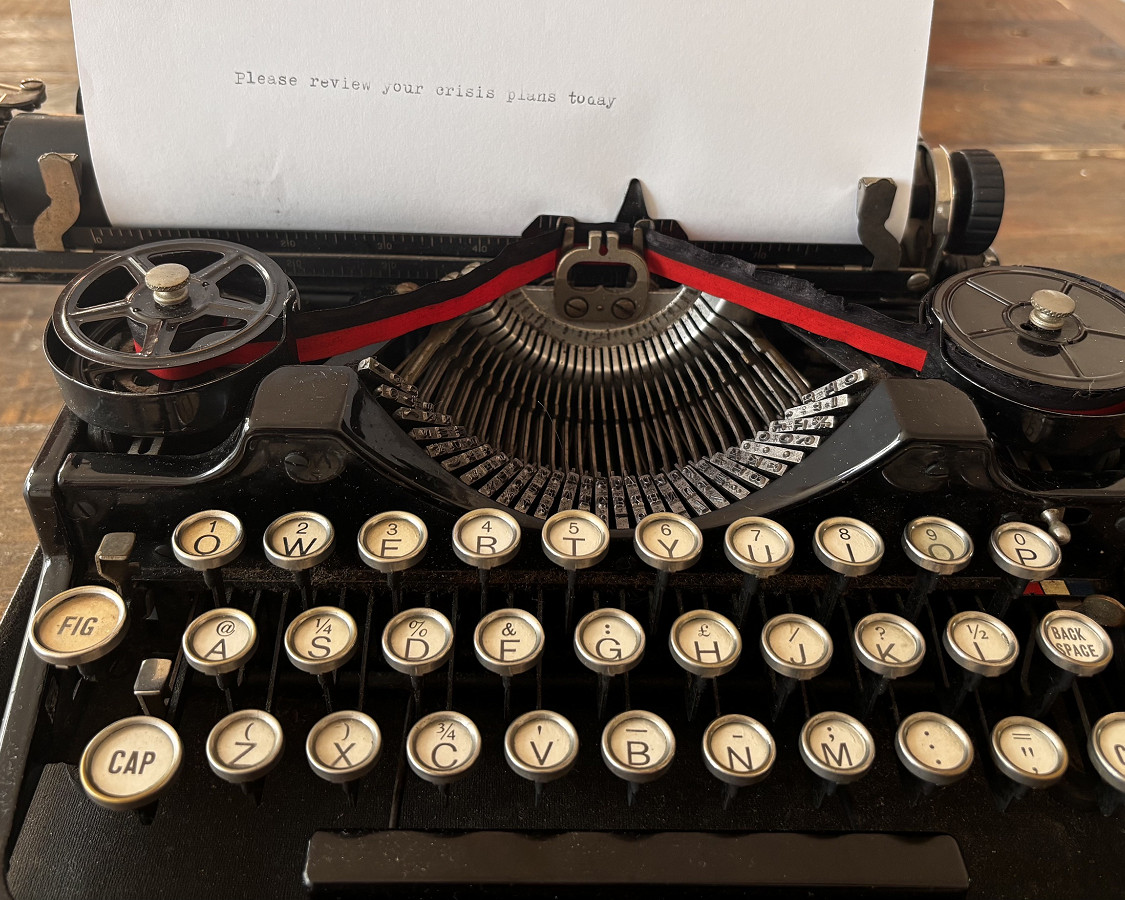
If you do one thing today, please check when your crisis plan was last reviewed
03 July 2026
In her latest Sidekick PR blog, Charlotte Dimond reiterates the importance of regularly checking your organisation's crisis plan.
Whenever we talk about crisis plans, major incident plans or business continuity plans, whatever you choose to call them, you see some people shuffling uncomfortably in their chairs as they don’t have a document to help guide them in a crisis. You then see the people making eye contact, happy in the knowledge that they have a plan. However, confidence often disappears when you ask when that plan was last reviewed, or how many people in their organisation know about it and know how to access it.
Having a plan is not enough.
One of our crisis services at Sidekick PR is to review the plans that organisations have in place to guide them in crisis. We review them to see how robust they are on paper (we test them too, but that’s for later). One of the first things we check is when the last review date was. I’m sure you’ll not be shocked to hear that we’ve seen good practice, with plans reviewed annually, but we’ve also seen plans that have not been reviewed in the last decade.
Just think about how much the world has changed in 10 years, how much your organisation has changed in the last 10 years, and how much technology has changed in the last 10 years.
A plan written 10 years ago is not fit for purpose for a crisis today.
Contacts change and crises change
Quick to go out of date is the key personnel, people have moved on and their replacements have not been added to the plan. This can also mean that they are totally unaware that they are part of a Crisis Management Team (CMT), which is a real concern.
It’s not just the internal contacts that change quickly. Those support services and people you need to call on, and often rely on, in a crisis change quickly too. From the resilience officer at your local authority to your IT support team, relationships built in peacetime make a huge difference in a crisis. Make sure to keep them up to date – these people should be more than a number on a plan.
The types of crises an organisation can face also changes and these need to be kept up to date too. Pre‑2020, not many organisations had a global health pandemic in their plans. Vehicles being used as weapons is sadly something that we’ve seen more of over the past few years and now features in most plans, and the huge reputational risk brought about by advances in technology, with cyberattacks, deepfakes and disinformation, must now also be considered.
It doesn’t stop with the review
Once you’ve reviewed your plan, please do make sure that someone owns it. It needs to be someone’s responsibility to ensure that the document is up to date, reviewed at least annually, and tested.
Please also make sure that the people named in your CMT know that they are part of it, what role they would play in a crisis, and that they have a good understanding of what is expected of them. I’ve seen people named in plans who had no idea that they were in them.
Once the processes are in place for the regular review and the people involved know their roles it’s time for testing. It’s only by testing the plan that you find the gaps, what works on paper does not always work in practice. More on testing next week but for now, my plea returns to the first line: If you do one thing today, please check when your crisis plan was last reviewed.
Do get in touch if you need help reviewing your crisis plan. Drop us a line at info@sidekickpr.com with the subject Crisis Plan Review.